
Unrest in the West: From ICE Raids to Farmer Revolts
In recent years, a series of unsettling events has rocked Western societies. In the United States, aggressive crackdowns by Immigration and Customs Enforcement (ICE) have turned deadly – for example, in January 2026 an ICE agent shot and killed a 37-year-old woman, Renee Good, during an arrest in Minneapolis. (A second man, Alex Pretti, was fatally shot by immigration agents just days later under disputed circumstances.) Across the Atlantic, Europe has seen its own upheavals. In the Netherlands, farmers have staged mass revolts against government climate regulations, blocking highways with thousands of tractors and even clashing violently with police. One late-night protest in 2022 ended with a police officer firing a gun at a 16-year-old farmer’s son – a shocking escalation in what began as peaceful demonstrations. Meanwhile, social tensions around immigration have erupted into riots: in late 2023, a knife attack at a Dublin school (allegedly by a foreign national) sparked far-right mobs to rampage through the city, torching cars and buses. These events – from American streets to European farms – paint a picture of a Western world beset by chaos, anger and fear.
Never let a good crisis go to waste
Yet a provocative question looms: Are these crises purely organic, or are they being cynically stoked and exploited? A growing chorus of skeptics suspects that such unrest is not merely coincidental. Could it be that authorities and power brokers are allowing or even encouraging these flashpoints of chaos as a pretext to tighten their grip on society? It’s a contentious idea – some would call it conspiracy theory – but it warrants a closer, critical look. History has shown that when people are afraid and disorder reigns, the public can become more willing to accept draconian measures in the name of “security.” The pattern of problem–reaction–solution is well-known: first comes a crisis, then public outcry, and finally sweeping “solutions” that were previously unthinkable. As one oft-cited adage (attributed to Winston Churchill) goes, “Never let a good crisis go to waste.” In this article, we examine whether recent turmoil in the West is indeed paving the way for an unprecedented expansion of social control – from ubiquitous surveillance cameras to digital IDs, curtailed freedoms, and the specter of a high-tech “digital prison.”
The Shock Doctrine: Crises as a Catalyst for Control
Observers of government power have long noted that moments of crisis can serve as inflection points for radical policy shifts. After the September 11 attacks, for instance, U.S. authorities rapidly passed the Patriot Act, vastly expanding surveillance powers in ways that would have been politically impossible before. During the COVID-19 pandemic, we saw governments assume emergency authorities – enforcing lockdowns, tracking citizens’ movements via smartphone apps, and mandating digital health passes – measures that, a year prior, would have sounded dystopian. The COVID period in particular left a profound imprint: nearly 2.3 billion EU Digital COVID Certificates were issued in Europe alone, accustoming citizens to the idea of flashing a digital credential for permission to travel or enter public spaces. Billions of people experienced how quickly “normal life” could be curtailed by government decree, and how technology could be employed to monitor compliance. It is not surprising, then, that many emerged from the pandemic with a heightened concern that such emergency measures might quietly become permanent tools of control.
Leaders and strategists are well aware of the opportunities crises provide. “Never let a serious crisis go to waste,” as one politician famously quipped. In other words, moments of public fear or anger can be harnessed to implement policies that, under calmer conditions, would meet stiff resistance. This dynamic is sometimes called the “shock doctrine” – the idea that shocks to society (wars, attacks, economic collapse, pandemics, etc.) can be used to push through controversial changes while citizens are too distraught to object. We should ask: are today’s bouts of unrest being similarly leveraged? When ICE agents’ raids turn deadly, or when farmers blockade cities, the public naturally cries out for order and safety. Does this reaction inadvertently play into the hands of those who want to introduce ever-more stringent surveillance and control? It’s a strategy as old as politics itself: create (or capitalize on) a problem, incite a fearful reaction, then present a prepackaged solution that expands your power.
Consider the Dublin riots mentioned earlier. In the wake of that violence, Irish Prime Minister Leo Varadkar quickly vowed to use “the full machinery of the state” against rioters and announced plans to tighten hate speech laws and enable greater use of CCTV surveillance by police. Few citizens opposed these moves – after all, who wouldn’t want to stop rampaging neo-Nazi hooligans? But the end result is that Ireland will now likely have more surveillance cameras watching its streets and broader laws policing speech. Likewise, in the U.S., public outrage over incidents like the Renee Good shooting has led to calls for better monitoring and accountability of federal agents – possibly through body cameras or expanded internal surveillance – and even fueled debates about labeling certain immigrant-rights protesters as security threats. Each crisis, from different sides, can spur demands for someone to “do something” – be it cracking down on violent protesters, or cracking down on overzealous police. And “doing something” often translates to empowering the state with new tools and tech.
Marching Toward a Surveillance Society
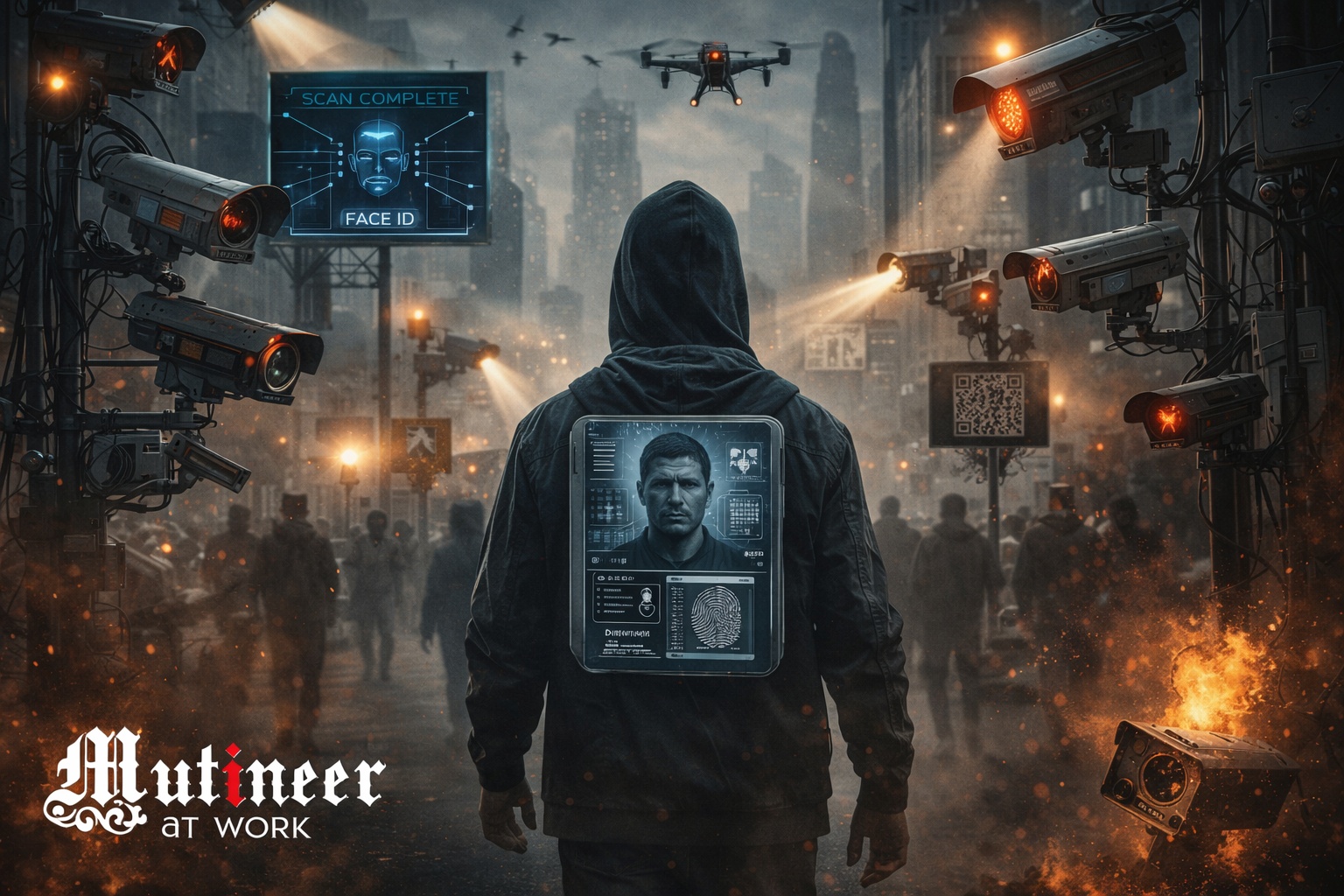
One of the most visible manifestations of creeping social control is the explosion of surveillance cameras. Nowhere is this more stark than in China, which has built an unparalleled Orwellian camera network. By 2021 China had an estimated 700 million CCTV cameras operating under its notorious “Skynet” system – roughly 494 cameras per 1,000 people, almost one camera for every two citizens. On city streets in China, literally every few paces another lens is watching, often augmented by facial recognition AI. Western officials have long tut-tutted China’s surveillance state as an affront to civil liberties. Yet, disturbingly, many Western countries are eagerly installing their own vast camera grids. London, for example, now boasts about 627,000 CCTV cameras for its 9.3 million residents – that’s around 67 cameras per 1,000 people, the most-monitored city in the democratic world. In the U.S., cities like New York, Chicago and Los Angeles have tens of thousands of public cameras, not to mention all the private security cameras that police increasingly tap into. A recent analysis found that the average global city (excluding China) has 5.8 cameras per 1,000 people, and that number climbs every year.
The push for more eyes in the sky is often justified by crime prevention or counter-terrorism. But there is a fine line between safety and surveillance. Western governments watched the effectiveness of China’s all-seeing networks with a mix of envy and apprehension. Now, under the banner of combating everything from riots to pandemics, they have begun adopting similar tactics. For instance, some cities are linking private retail and home cameras into centralized police systems, granting law enforcement real-time access to what used to be personal CCTV feeds. The result is an expanding panopticon where fewer and fewer moments of public life go unrecorded. After enough unrest and emergencies, constant surveillance starts to feel “normal” – even necessary – to many people. We start to internalize the notion that being watched is the price of being safe. It’s worth remembering that such surveillance, once in place, rarely ever fully retracts; instead, it often grows. Temporary cameras installed for a high-profile event or protest tend to become permanent fixtures. And as the number of cameras approaches the density seen in China, so too does the potential for China-style social control via monitoring.
Normalizing the Digital ID and Cashless Control
Alongside physical surveillance, Western governments and corporations are racing to establish systems of digital surveillance and identification. High on this agenda is the idea of a universal digital identity for every citizen. The European Union is already developing an “EU Digital Identity Wallet” intended to be available to all EU residents by 2026, effectively a personal digital ID on your smartphone that you would use for everything from banking to healthcare to logging into government websites. Officially, the EU pitches this as a convenient, privacy-preserving tool – “based on the principle that everyone should always control their digital identity”. However, privacy advocates worry that such unified digital IDs could become de facto mandatory for participating in society, and that they might centralize an alarming amount of personal data. Even a World Economic Forum (WEF) report – coming from the very organization eagerly promoting digital IDs – acknowledged the “significant risks” involved, including exclusion, surveillance and oppression. The WEF noted that digital ID systems, if misused, could “facilitate the identification, surveillance and persecution of individuals or groups,” and that once an ID becomes widespread, opting out can become “effectively unavoidable” for citizens. In other words, choose not to carry “your papers,” and you might be effectively barred from society.
Digital IDs tie into a larger ecosystem of control. Combine a universal ID with the abolition of cash, and you get total financial visibility – and by extension, control over every transaction. This is not theoretical; it’s already happening. Countries from Sweden to Australia are racing toward cashless economies, and central banks are exploring Central Bank Digital Currencies (CBDCs) which would replace physical money with trackable digital tokens. The WEF and other elite forums champion a cashless future, touting benefits like convenience and crime reduction. But we got a sneak preview of the dark side during Canada’s 2022 “Freedom Convoy” protests, when the Canadian government froze the bank accounts of protesters and donors without any court order. With a keystroke, people who had committed no crimes (other than supporting an unpopular protest) lost access to their own money – an extraordinarily powerful method of coercion. Now imagine a CBDC system where every dollar is programmable: authorities could automatically restrict what you spend money on, or turn off your funds if you don’t comply with some policy. Dissent becomes financially impossible. This isn’t sci-fi; insiders openly discuss these capabilities. In fact, after the trucker incident, Canada’s Finance Minister ominously suggested those emergency financial tools could be used again in the future if needed. A “digital prison” starts to take shape: you might not see the bars, but step out of line and you’ll quickly feel them – your money stops working, your vaccine passport QR code turns red, your digital ID gets flagged at every checkpoint, and every camera on the street is looking for you.
The Transhumanist Agenda and The Great Reset
No discussion of orchestrated social control would be complete without addressing the World Economic Forum and its much-publicized “Great Reset” initiative. The WEF – led by the now quasi-famous Klaus Schwab – is often cast (for better or worse) as a shadowy orchestrator of global agendas. While some of the wilder theories about the WEF veer into fantasy, there’s no question that this elite organization envisions a very different future from the status quo, one that blurs the line between human and machine, public and private, personal and political. Schwab himself has written at length about the Fourth Industrial Revolution, describing a coming era of “a fusion of our physical, digital and biological identities”. That phrase, frankly, sounds transhumanist – implying technology will literally become embedded in us and around us to the point that human life as we know it is transformed. The WEF’s pet topics – digital IDs, implantable microchips, genome editing, AI monitoring, smart cities, “algorithmic governance” – all feed into a vision of total technocratic management of society. Not by coincidence, these are the very technologies that could enable an unprecedented degree of surveillance and control over individuals.
Critics also point to the infamous WEF slogan: “You’ll own nothing, and you’ll be happy.” This phrase originated in a 2016 WEF-affiliated essay imagining life in 2030. It was supposed to be a provocative scenario about a friendly “sharing economy.” But after COVID and the Great Reset rollout, that line took on a menacing new hue for many. To skeptics, “own nothing and be happy” sounds like the endgame of a neo-feudal agenda: average people stripped of private property and privacy, pacified under a system of pervasive surveillance and AI-managed “happiness.” The WEF has since denied that it literally intends to abolish personal property. Yet it’s undeniable that many WEF-endorsed policies (carbon taxes, urban “15-minute city” designs, digital currencies, etc.) would diminish individual ownership and increase centralized control of resources. Furthermore, WEF influence in governments is well-documented. Klaus Schwab has bragged on record that his World Economic Forum “penetrates the cabinets” of governments by installing its Young Global Leaders in positions of power. In 2017 he noted with pride that at least half of Canada’s Cabinet were WEF Young Leaders, including the Prime Minister. It’s no wonder that policies harmonized with the WEF’s agenda have popped up almost in unison across many Western nations – from digital health passes to “green new deals” to the eager embrace of digital ID frameworks. Is this a vast coordinated conspiracy or just like-minded elites thinking alike? The answer may depend on one’s level of skepticism, but the effect is the same: a globally coordinated push toward more digital monitoring and managed outcomes in our societies.
At least half of Canada’s Cabinet were WEF Young Leaders, including the Prime Minister
Resisting the Normalization of the “Digital Cage”
If the scenarios above sound bleak, it’s because they are. Yet, recognizing this trajectory is the first step to resisting it. The recent unrest in the West – whether deliberately stoked or not – is undeniably being used to accelerate changes that inch us toward a tightly controlled future. Frightening incidents (be they terrorist attacks, violent protests, or pandemics) create a public appetite for strong responses. And time and again, those responses share a common theme: greater surveillance, more centralized data, and less personal autonomy. Each new CCTV camera, each new digital ID program, each new algorithm watching our posts or transactions, is sold to us as a solution to some crisis or another. Piece by piece, a high-tech web is woven around us, often so gradually that we accept it as inevitable or even benign.
But nothing about this is inevitable. We, as citizens, still have agency – if we choose to use it. Being aware is crucial. It’s not “paranoid” to question why our cities suddenly need Chinese-level camera coverage, or why private data must be pooled in government ID clouds. Healthy skepticism and civic pushback can slow or alter these programs. For example, public outcry in some EU countries over COVID pass schemes and “chat control” surveillance proposals has forced officials to reconsider or add privacy safeguards. In the US, courts have at times rolled back overzealous surveillance (though often only after the fact). The key is not to wait until the digital prison door has slammed shut. We must challenge the narrative that trades liberty for security every single time – demand evidence that these intrusive measures truly solve the problems they claim to, and insist on sunset clauses and oversight.
The Mutineer spirit – that individual spark of defiance against groupthink and authoritarianism – must be kept alive. It’s time to ask uncomfortable questions: Who benefits from a society where everyone is tracked and every action logged? Are we being conditioned to accept ever-less privacy and freedom due to fear? As citizens in democracies (at least for now), we should remember that governments derive their legitimacy from our consent. It’s entirely appropriate to say, “No, we do not consent to living under ubiquitous surveillance,” or “Yes, we want safety, but not at the cost of becoming a QR code in a database.” The answer to social problems need not be a slide into digital dictatorship.
No, we do not consent to living under ubiquitous surveillance,
Stay alert. Stay critical. The next time a crisis dominates the headlines and sweeping measures are proposed in response, take a moment to think: Is this truly a proportional solution, or just a convenient one for those in power? Realize that once we normalize measures like facial recognition on every corner, or ID checks for every login, we may never fully regain the privacy and liberty we ceded. The march toward a tech-enabled tyranny is only inevitable if we allow it to be. By maintaining our skepticism and making our voices heard, we can demand solutions that enhance security without shackling society. In the end, a camera may watch two citizens, but 200 citizens watching their government is a far better guarantee of freedom.
Call to awareness: Let’s not sleepwalk into a surveillance dystopia. Share this knowledge, question the narratives, and engage in your community’s decisions. The price of liberty is eternal vigilance – now, more than ever.




Leave a Reply