
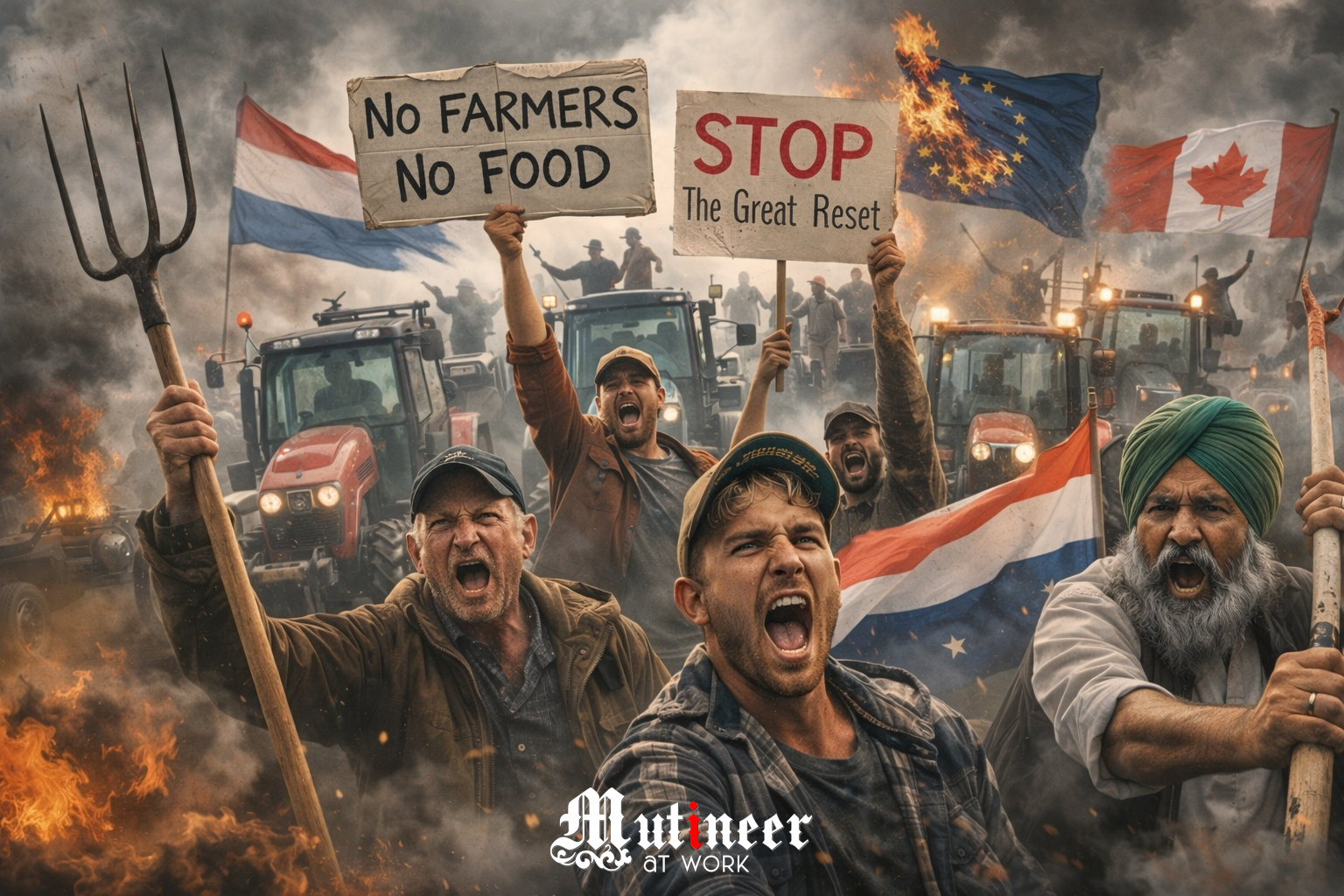
Brussels, Belgium – Late 2025: A wave of farmer protests has swept across Europe and beyond over the past two years, as thousands of farmers took to the streets with tractors and pitchforks. From the heart of Brussels to the fields of India, they are pushing back against policies they say threaten their livelihoods and food security. These measures – ranging from nitrogen emission caps and land use restrictions to trade deals and new taxes – are viewed by many farmers as part of a top-down “2030 agenda” driven by global elites. In an era of climate goals and economic resets, the world’s farmers are making their voices heard in raw, unfiltered fashion.
In this multi-country report, we delve into the farmer protests of 2024–2025 in Belgium, the Netherlands, Germany, France, Greece, the UK, Canada, and India. We examine the farmers’ grievances, the government actions prompting them, and why many in the farming community believe these policies align with the World Economic Forum’s Great Reset 2030 vision. We also look at how authorities have responded – sometimes with force – and how media narratives have framed this growing rebellion.
No Farmers, No Food
“No farmers, no food,” the protesters proclaim. Here’s what’s happening on the frontlines of this global farmer uprising.
Belgium: Tractors Besiege Brussels
In Belgium, farmer discontent has been mounting over both environmental regulations and international trade deals. In March 2023, Flemish farmers rolled into Brussels with over 2,700 tractors, bringing traffic to a standstill. Their anger was directed at proposed nitrogen emission rules that mirror those in the Netherlands – measures to halve ammonia and nitrogen oxide pollution by 2030, which could force farms to downsize or shut down. Farmers argued these rules were too drastic and would “end their livelihoods”, a fear echoed by their peers across Europe. By January 2024, Belgian farmers were staging repeated demonstrations against what they dubbed a “nitrogen crisis” policy, highlighting uncertainty and stringent climate targets that politicians kept postponing under industry pressure. The Wallonia Federation of Agriculture decried “complicated legislation and an excess of red tape,” warning that the pressures on farmers affect the entire population.
Belgian farmers also bristled at global trade policies they see as unfair. On December 18, 2025, as EU leaders debated a long-awaited EU-Mercosur free trade agreement, thousands of farmers flooded Brussels in protest. They fear the deal will “flood [Europe] with cheaper South American goods,” undercutting local producers. The demonstration turned violent when some hurled rocks and even potatoes at police, and one enraged farmer drove a tractor into a line of riot officers. Belgian police responded with tear gas and water cannon, clashing with protesters in scenes of chaos outside EU institutions. Authorities had authorized a small tractor presence, but around 1,000 tractors showed up with an estimated 7,000 farmers, vastly exceeding expectations.
For Belgium’s farmers, the common thread in these protests is a sense of being squeezed from all sides: caught between EU green mandates on one hand and global trade agreements on the other. “Cheap commodities could flood the market to the detriment of European producers,” they warn. To them, policies crafted in Brussels – whether for climate or commerce – seem increasingly detached from the realities on the ground.
The Netherlands: Revolt of the Dutch Farmers
No country’s farmers have grabbed global headlines quite like those in the Netherlands, where a full-blown farmers’ revolt has been raging against environmental regulations. The Dutch government’s plan to cut nitrogen emissions 50% by 2030 – in line with EU biodiversity directives – would require drastic reductions in livestock and even forced buyouts of farms near protected nature reserves. “The honest message…is that not all farmers can continue their business,” the government admitted in 2022 when unveiling the targets. Many farmers saw this as an existential threat. In response, they launched massive protests starting in 2019 and intensifying through 2022–2023, bringing the tiny nation to a standstill.
Dutch farmers deployed radical tactics: swarming highways with thousands of tractors, dumping manure and hay bales on roads, and even besieging officials’ homes. In one incident, a 16-year-old farmer driving a tractor was shot at by police during a highway blockade in July 2022, sparking outrage. Nineteen protesters were arrested at a distribution center blockade that same week. (The officer who fired on the teen is now being prosecuted.) Farmers’ Defense Force, a militant farmer group, mobilized in solidarity, and the detained teenager – initially accused of attempted vehicular assault – was released after the allegation was withdrawn. Such clashes only steeled the farmers’ resolve.
The Dutch “nitrogen law” became a lightning rod. Nature Minister Christianne van der Wal bluntly stated that some farms would have to shut down “either voluntarily or through compulsory purchase” to meet legal emission limits. This fueled farmers’ suspicions that the agenda was being driven by something (or someone) beyond the Netherlands. Upside-down Dutch flags became a symbol of resistance – a sign of national distress – and slogans like “No farmers, no food!” rang out at tractor rallies. What began as a fight over fertilizer runoff quickly morphed into a broader rural rebellion against urban elitism and global green mandates.
By March 2023, public sympathy for the farmers translated into a political earthquake: the upstart Farmer–Citizen Movement (known by its Dutch acronym BBB) won the most seats in the Dutch Senate on an anti-nitrogen platform. And in late 2023’s general election, outrage over farm policies and other issues toppled the ruling coalition. A new, fragile coalition government took shape in 2024 that included the BBB party – a testament to farmers’ political clout. In early 2025, however, a Dutch court ruling upped the stakes again, ordering the government to enforce the 2030 emission cuts more aggressively or face fines. Environmental groups hailed the verdict, but farmers and even the new coalition partners balked. “We don’t need more nitrogen policies. We need to loosen nitrogen rules and targets!” tweeted Geert Wilders, whose party joined the coalition. The agriculture minister warned that “we can’t ask the impossible of people and companies”.
Dutch farmers feel they’ve been “picked as the scapegoat” for a pollution problem that also implicates industry and traffic. Any solution, officials admit, “involves a large cut in the number of farms and livestock” in the country. To the farmers, this sounds like social engineering – a forced transformation of rural life. Their protests, sometimes fierce and even violent, have been a warning heard around the world. As one Dutch dairy farmer put it, “They want to erase us, but we are not going quietly.”
They want to erase us, but we are not going quietly.
Germany: “Too Much Is Too Much” – Fuel Subsidies and Beyond
In Germany, thousands of farmers staged their own demonstrations, underscoring that it’s not just climate rules driving farmer anger but also economic blows. On January 15, 2024, an estimated 30,000 protesters – led by farmers – brought central Berlin to a halt with a convoy of tractors, trucks, and even forklifts. They were protesting the government’s plan to phase out a rebate on diesel fuel used in agriculture, a subsidy cut aimed at climate goals and budget savings. Farmers argued that ending the tax break would send their fuel costs soaring and “drive many farms to bankruptcy”. “This much is too much. Take back the proposal!” demanded Joachim Rukwied, president of the German farmers’ union, from a stage at the Brandenburg Gate.
The Berlin tractor rally – dubbed by some the largest in memory – had an interesting twist: it drew support from other professions and industries. Fishermen, truckers, restaurateurs, tradespeople, and more joined in solidarity. High energy costs, burdensome regulations, and inflation had created a wider coalition of the discontented. Even Germany’s finance minister, Christian Lindner (the architect of the fuel subsidy cut), showed up at the rally – only to be drowned in boos and whistles. “Your protest is legitimate and peaceful,” Lindner told the crowd, acknowledging that “something has been brewing for decades…we need to talk.” But his assurances barely carried above the angry noise. When night fell, tractors blared horns and even revved chainsaws as they entered the capital, fraying the nerves of Berliners and prompting heated exchanges.
German farmers’ grievances go beyond a single subsidy. The protest wave in Germany that week saw tractors blocking roads nationwide and rallies against an array of issues: steep fertilizer and pesticide regulations, high costs of new climate compliance rules, and the feeling of rural communities being ignored. Commentators noted that the far-right Alternative für Deutschland (AfD) party eagerly fanned the flames, characterizing farmers’ anger as part of a broader revolt against Berlin’s policies. Indeed, placards at the protest accused the government of “cronyism” and worse. But for many ordinary farmers, this was fundamentally about survival: “The government must not keep coming for agriculture,” one banner read, “We take care of your food”.
Ohne Bauern, kein Brot
By forcing the government to at least temporarily reconsider the diesel tax plan, German farmers proved they could flex their muscle. Their slogan at the Brandenburg Gate was pointed: “Ohne Bauern, kein Brot” – without farmers, no bread. It’s a message resonating across borders.
France: Roadblocks, Rage, and a Reality Check
In France, where farming is deeply woven into national identity, farmers launched some of the most dramatic protests of early 2024 – and paid a heavy price. Starting in January 2024, French farmers began blocking highways and border routes with their tractors, protesting what they called impossible pressures on agriculture. They cited “unfair prices, excessive taxes, and overzealous green regulations” as a triple threat to their livelihoods. The timing was sensitive: President Emmanuel Macron’s government had been touting its success in forcing food retailers to lower prices to fight inflation, which farmers say translates into lower farm-gate prices for them. Essentially, French farmers felt squeezed between cost-cutting economic policies and cost-increasing environmental rules – a contradiction they found untenable.
The protests, which started in southern Occitanie and spread nationwide by late January, turned tragic on January 23, 2024. In the southwest Ariège region, a car slammed into a makeshift barricade of hay bales that farmers had set up on a rural road. A 55-year-old farmer, Corinne Passet, and her 16-year-old daughter were struck and killed, and her husband severely injured. The horrifying accident stunned the country. France’s new Prime Minister, Gabriel Attal, acknowledged that “all of rural France is in grief today” and rushed to meet farm representatives. Agriculture Minister Marc Fesneau somberly noted the farmer died “while defending her profession”, as he canceled meetings in Brussels to visit the scene. The tragedy underscored how high the stakes have become in these protests.
Even before the fatal incident, French farmers were pulling no punches. Across the country, they parked tractors on highways (even the busy A16 to Calais) and lit bonfires of tires and straw. One widely seen banner strung between tractors read: “Let’s not import what is prohibited in France.” This was a jab at the perceived hypocrisy of EU policy – banning certain pesticides or farming methods at home while considering trade deals (like Mercosur) that allow imports of goods produced under laxer standards. “The contradiction is glaring,” said Patrick Benezit of the French cattle farmers union, criticizing the EU for pushing stricter environment rules “while also pursuing free trade deals” that disadvantage European farmers. French farmers, like their Belgian neighbors, resent being told to go green and go broke at the same time.
Under pressure, the French government signaled some willingness to address farmers’ concerns. Prime Minister Attal held emergency talks and promised “concrete solutions” on issues from pricing to red tape. President Macron, wary that the powerful farming lobby could swing rural votes toward Marine Le Pen’s far-right party in upcoming European Parliament elections, tweeted that the government would be “fully mobilized” to help farmers. But he also warned against “demagogy and simple answers” in the face of the crisis. Meanwhile, farmers vowed to continue roadblocks until they saw real action. As Arnaud Gaillot of the Young Farmers union put it, “The time of talking is over. We need action.” For now, the standoff in France remains tense – a reminder that in the EU’s largest agricultural nation, farmers’ patience is running out.
Greece: Blockades and Betrayal in the Birthplace of Democracy
Greece’s farmers have a history of militant protest, and 2025 proved no exception. In late 2025, Greek farmers embarked on nationwide highway blockades, port shutdowns, and even airport invasions to demand long-overdue support. By December 2025, thousands of tractors and trucks were parked across major routes, intermittently sealing off border crossings with Bulgaria and Turkey and choking highways between Athens and Thessaloniki. In one audacious action on the island of Crete, furious farmers stormed onto the runway of Heraklion International Airport, tossing rocks amid clouds of tear gas and forcing flights to be halted. “It’s a matter of survival,” declared Yiannis Koukoutsis, a farmer in Larissa, as he manned a blockade. “We’re looking for good faith from the government… We need help, not promises.”.
The spark for the Greek protests was a feeling of betrayal over EU subsidies. Farmers discovered a massive €600 million shortfall in expected EU agricultural aid, after a corruption scandal prompted authorities to freeze payments. (A scam involving fake land claims had led to audits, delaying all disbursements.) This financial hit came just as Greek herders were reeling from a devastating sheep pox outbreak that forced the culling of hundreds of thousands of animals. In other words, a perfect storm: no subsidies, diseased flocks, rising costs. The center-right government of Kyriakos Mitsotakis pleaded for patience and vowed to release emergency funds, but trust had already evaporated.
For over two weeks, the farmers kept up rotating road and port closures. Key freight corridors to the Balkans were repeatedly shut. In Greece’s agricultural north, trucks sat idle for hours at the Promachonas border crossing. On Crete, riot police confronting farmers at the airport were met with a barrage of stones and rage. The government, embarrassed and under fire, agreed to new talks and started paying out some aid early. But farmers didn’t dismantle the barricades right away. They warned of more extreme actions if Athens didn’t make them whole.
To many Greek farmers, this episode confirmed a long-held grievance: that the authorities only notice agriculture when things reach a boiling point. “We have to block roads and airports just to be heard,” lamented one protest leader on Greek TV. As of late 2025, the Greek farmer revolt has echoed similar uprisings abroad, with one Greek outlet noting that it “echoes farmer actions across Europe in 2024”. The implication is clear – whether it’s nitrogen quotas or missing funds, the farming sector feels under attack, and they will take drastic steps to defend what they see as their very right to survive.
United Kingdom: The Great British Tractor Rebellion
Even the UK, often thought of as removed from EU regulations post-Brexit, has seen farmers rising up against their government’s policies. In late 2024, British farmers launched what some dubbed the “Great British Tractor Rebellion” in response to a surprise move by the government: new inheritance tax rules on farmland. In the October 2024 Budget, the (then) Labour government proposed ending long-standing tax reliefs on agricultural land, meaning family farms passed down to the next generation could face hefty “death taxes”. For many UK farmers, this felt like a direct assault on the tradition of the family farm – potentially forcing farm heirs to sell land to pay tax bills. “It will ruin family farms,” protesters warned, accusing the government of seeing farms as mere assets to tax rather than vital national infrastructure.
On November 19, 2024, hundreds of tractors rumbled into central London. They converged on Parliament Square and Whitehall, snarling traffic in an intentional slow-roll convoy. Farmers in flat caps and wellies stood atop their vehicles, shouting that they felt betrayed by politicians in the very moment the UK was trumpeting “food security.” Outside Westminster, placards read “No Farms, No Food” and even cheeky puns like “Time for a Ewe-turn!”. The National Farmers’ Union (NFU) organized many of the protests and even brought lambs to graze outside Parliament as a visual plea. Smaller demonstrations sprang up across the country: farmers rallied at Dover port (driving tractors onto the beach) to highlight how policy changes, from taxes to trade deals, threaten British agriculture. In Scotland, farmers massed at the Holyrood Parliament in Edinburgh to voice related concerns about funding and land reform.
The UK government initially defended the inheritance tax change as closing a loophole exploited by wealthy investors (some rich individuals had been buying farmland mainly for tax benefits). But genuine family farmers felt lumped in and punished. The uproar grew so loud that even media personalities took note – Jeremy Clarkson, a celebrity farmer after his TV farm show, publicly blasted the policy (and tangled with the BBC over it). By early 2025, the pressure was mounting. “We may have to take more extreme action,” NFU leaders hinted after an initial tractor march, noting that farmers could not rule out prolonged disruptions if the so-called “tractor tax” wasn’t scrapped. Indeed, in February 2025, another wave of tractor protests descended on Whitehall, indicating the fight was far from over.
The British farmer protests show that even outside the EU, farmers see themselves as under siege from elite policy goals. Whether it’s trade deals allowing in foreign food or tax policies threatening land ownership, UK farmers joined the chorus: “You can’t keep coming for agriculture.” Their rebellion has a distinctly British flavor – polite but firm, witty yet angry – and it underscores that the concerns of farmers transcend borders.
Canada: “No Farmers, No Fertilizer Cuts”
On the other side of the Atlantic, Canadian farmers have been raising alarms about their government’s environmental targets, which echo Europe’s and are often explicitly tied to 2030 climate goals. The flashpoint in Canada is fertilizer use. In 2022, Prime Minister Justin Trudeau’s government announced a plan to reduce nationwide emissions from nitrogen fertilizers by 30% by 2030 – a goal nearly identical to the Dutch nitrogen reduction scheme. Although officials insist this target is “voluntary” and about efficiency, farmers fear it will in practice mean forcing them to use about 20% less fertilizer, which could dramatically lower crop yields. One study commissioned by industry projected a $48 billion loss in farm revenue over eight years if the 20% fertilizer cut were implemented.
Farmers across Canada – especially grain growers on the Prairies – reacted with incredulity. “At a time when the world is struggling with food security, the last thing we need is imposed targets that make it harder to grow food,” Ontario’s Agriculture Minister Lisa Thompson said, blasting the federal plan. Her counterparts in Saskatchewan and Alberta were even more livid. They revealed that the federal government had dropped the 30% target on them as a fait accompli, with little consultation. To many, this confirmed their suspicion that Ottawa was copying policies from abroad without regard for Canadian realities. Indeed, a Farmers Forum headline in 2022 declared: “Canada set to copy Dutch plans for farming”. Around that time, solidarity protests even popped up – such as a rally of Eastern Ontario farmers in July 2022 flying upside-down Dutch flags to support Dutch farmers opposing nitrogen rules.
Throughout 2023 and 2024, Canadian farm organizations lobbied hard against the fertilizer emissions plan. While large street protests have been rarer than in Europe, farmers made their case in public hearings, op-eds, and even by joining broader anti-government movements. Elements of the 2022 Freedom Convoy protests (ostensibly about COVID mandates) overlapped with farmer grievances, both driven by a distrust of Trudeau’s “globalist” policies. In Western Canada, some farmers talked of forming tractor convoys if Ottawa tried to mandate fertilizer reductions. The Western Canadian Wheat Growers and Fertilizer Canada ran campaigns warning that a 30% cut would “have severe downstream impacts” on food supply and actually increase global carbon emissions by shifting production overseas. Under pressure, the Trudeau government repeatedly stressed the 30% goal was “not a mandatory reduction in fertilizer use”. But at the same time, it poured nearly half a billion dollars into programs to curb on-farm emissions. Farmers note that such incentives could become pressures, especially if tied to access to federal funding. “Hardly voluntary if it’s linked to money,” critics say.
Canadian farmers’ mistrust of the agenda is palpable. They point out that Canada’s targets came right after similar EU goals, almost as if coordinated. The World Economic Forum’s influence is a common talking point in rural coffee shops: it doesn’t escape notice that Canada’s Deputy PM is a WEF board member, or that Trudeau himself mused in 2020 that the pandemic was an “opportunity for a reset.” Under the slogan “No Farmers, No Food,” Canadian producers have started to “finally rise up,” according to some observers. They see themselves as standing in solidarity with Dutch farmers, and indeed at some rallies you’ll spot both Canadian maple leaf flags and inverted Dutch tricolors side by side – symbols of a shared struggle.
India: The Unfinished Fight of India’s Farmers
India witnessed one of the largest farmer mobilizations in history from 2020 to 2021, when tens of thousands camped on Delhi’s borders for over a year, protesting new pro-corporate farm laws. Those laws were repealed after the determined peaceful resistance. But Indian farmers’ fight didn’t end there. In late 2023 and early 2024, Indian farmers regrouped to demand a legal guarantee of minimum crop prices, among other promises that remained unfulfilled after the earlier protests. Their focus is securing an assured Minimum Support Price (MSP) for all major crops – a protective floor price to keep farmers out of crushing debt.
In February 2024, as many as 50,000 farmers from Punjab, Haryana, and other northern states began a march towards New Delhi on tractors and trailers. They were stopped by authorities about 125 miles from the capital, who erected concrete barricades and even used drones to drop tear gas on the advancing farmers. Police detained several protesters and suspended mobile internet in the area – tactics reminiscent of the crackdown during the 2020–21 protests. In solidarity, farmers across India held a one-day nationwide strike, blocking highways and holding rallies from the rural north to as far south as Hyderabad. Support from labor unions and opposition parties swelled the ranks in some places.
By mid-March 2024, thousands of farmers converged in Delhi’s Ramlila Ground for a massive rally. They came by crowded buses and trains, shouting slogans for “Karza Mukti, MSP Kanoon” (freedom from debt, MSP law). The Samyukt Kisan Morcha – the united front of farmer unions – declared that if the government did not pass an MSP Guarantee Act, they would intensify agitation in the lead-up to India’s 2024 general elections. “They have forgotten that behind every meal is a farmer’s toil,” one protest leader said, echoing a sentiment shared by farmers globally.
The Indian government of Prime Minister Narendra Modi has been wary of another long farm standoff. After initially dismissing the MSP demand, by late March 2024 it opened a dialogue and offered some compromises (such as committee discussions and tentative price increases for certain crops). But distrust remains high. Farmers recall how, during the prior protests, the government attempted various crackdowns – from freezing bank accounts and issuing arrests to maligning protesters as “extremists”. In one infamous episode on January 26, 2021 (India’s Republic Day), a tractor convoy rally in Delhi turned violent, leading to clashes and a protester’s death. The government temporarily took a hard line, even digging trenches and barricading protest camps with spikes. Yet the farmers persisted calmly until the government had to relent.
That victory emboldened farmers worldwide. Many leaders of the European farmer protests explicitly cited inspiration from India’s movement – a reminder that when farmers unite, they can shake even the firmest governments. India’s farmers are now vigilant that global corporate agendas – whether via free trade deals, World Trade Organization pressures, or WEF-style modernization schemes – do not steamroll their rights. As veteran Indian farm leader Rakesh Tikait famously said, “If the farmer is weak, the country is weak. We are not just fighting for ourselves, we are fighting for the soul of our nation.”
If the farmer is weak, the country is weak.
We are not just fighting for ourselves, we are fighting for the soul of our nation.
The Great Reset vs. The Great Resist: A 2030 Agenda?
Are these disparate farm protests connected by something bigger? Many farmers believe yes – they are pushing back against a coordinated global agenda. Specifically, they point to the World Economic Forum’s “Great Reset 2030” vision and related policies (like the UN Agenda 2030 Sustainable Development Goals and corporate ESG frameworks) as driving forces behind the new rules.
From the farmers’ perspective, it’s no coincidence that so many countries suddenly introduced 2030 deadlines to slash agricultural emissions or rethink land use. The WEF itself has openly called for “reshaping” food production and supply chains to be more sustainable and centralized. In 2020, the WEF’s Food Action Alliance announced a plan to “transform the way we produce, supply and consume food” to meet the Sustainable Development Goals by 2030. Their vision entails fewer independent farms and more “public-private partnerships” in agriculture. A WEF press release argued that fragmentation in the food system – i.e., millions of farmers making their own decisions – is a hurdle to be overcome. Instead, it champions “new business models” where stakeholders (governments, big companies, NGOs, etc.) coordinate what farmers grow and how. Small farmers hear that and shudder – to them it sounds like the end of the family farm model. As one analyst put it bluntly, “The current food system is fragmented by private ownership…they can’t change the system unless they coerce those pieces to do what they want.” It’s the infamous “you’ll own nothing and be happy” scenario that has taken root in the popular imagination.
Dutch farmers, in particular, have been vocal about this. Prominent voices in their movement claim the Netherlands is a “pilot country” for the Great Reset – alleging that under the guise of the nitrogen crisis, the government aims to expropriate farmland and repurpose it for “sustainable” projects or urbanization in line with WEF ideas. These claims were supercharged by conspiracy theories online, some falsely suggesting Dutch farms were being cleared to build housing for migrants or mega-distribution hubs. The Dutch government denies such plans, but the perception among farmers that a global elite is engineering their downfall has been hard to dispel. As evidence, they point to things like Prime Minister Mark Rutte boasting about partnering with the WEF to host “Food Innovation Hubs” in the Netherlands – essentially making the country a showcase for WEF’s food strategy. They also note how closely the Dutch nitrogen targets align with EU and UN goals, suspecting external influence over national policy.
Farmers in other countries echo these suspicions. In Ireland and New Zealand (not covered in detail here), plans to cull cows to reduce methane have likewise been linked by critics to the Great Reset agenda. Canadian commentators talk about “globalists like Trudeau” forcing farmers to bear the brunt of “non-realistic climate goals.” And in the UK, the notion that urban elites want farmland for rewilding or corporate takeover underpins some opposition to new environmental land use schemes. Across the board, farmers feel that their way of life – independent, rural, tied to the land – is at odds with a vision of technocrats who favor large-scale, highly regulated, or even lab-grown food production by 2030.
It’s important to note that not everyone sees a nefarious plot. What farmers interpret as a “Great Reset” assault, many policymakers describe as necessary modernization. They argue that climate change does require transforming agriculture – albeit with support to help farmers adapt. The WEF and others insist they want to include farmers in dialogues. But the mismatch in perspectives is glaring: one side speaks of global targets, efficiency, and sustainability metrics; the other speaks of cultural heritage, autonomy, and feeding communities.
Independent experts have mixed views. Some environmental scientists say yes, fertilizer and emissions must be curbed, but criticise the top-down approach and lack of viable alternatives offered to farmers. Agricultural economists often highlight that farmers’ concerns about fairness are valid: for example, if EU farmers face higher costs due to green rules, allowing cheaper imports is indeed a serious policy inconsistency. Even the European Commission has started using terms like “just transition” for farmers, implicitly recognizing the risk of a backlash if policies are seen as one-sided. The farmers, for their part, are not anti-environment – many say they are stewards of the land who support reasonable green practices. But they bristle at being dictated to by distant authorities or seeing centuries-old farms disappear in a spreadsheet-driven push to meet ESG goals by a certain date.
In sum, while the phrase “Great Reset” might sound like a conspiracy to some, for these farmers it’s become a catch-all for very real trends they are experiencing: centralization, loss of control, and a future being decided without them at the table. Their protests are, in effect, a demand to be heard – and a warning that they won’t simply sit back and “trust the plan” for 2030.
Crackdowns, Media Spin, and Public Reaction
Governments have not stayed idle in the face of these rolling farm protests. Many authorities have responded with crackdowns – some measured, some heavy-handed. Police in numerous countries have been tasked with balancing the right to protest with maintaining order, and sometimes they’ve crossed lines, further fueling farmers’ anger.
In the Netherlands, as noted, police at one point fired live rounds at a tractor whose driver refused to stop at a blockade – thankfully injuring no one, but shocking farmers who thought such force unthinkable. Dozens of Dutch protesters were arrested over the course of 2022’s actions. The Dutch government even put the national counter-terrorism agency (NCTV) on alert about the farmer movement, worried that extremist elements were piggybacking on it. (The NCTV did find that while the protests were largely peaceful, conspiracy theorists and far-right agitators were indeed trying to co-opt them.) When some militant Dutch farmers stormed the private home of Minister van der Wal and vandalized property, it prompted the government to beef up her security and condemn the intimidation tactics. Farmers’ leaders disavowed violence but warned that desperation was driving the fringes to act out.
In India, the 2020–21 protests saw significant crackdowns: water cannons in winter, tear gas barrages, barricades of barbed wire and concrete on highways, and coordinated social media blackouts around protest sites. At one point the government even dug trenches on roads to stop tractor processions. Internationally, these images drew criticism and solidarity – the sight of elderly Sikh farmers facing police lathi (baton) charges stirred outrage. Eventually, India’s government realized force was backfiring and shifted to negotiations. The farmers’ grit under pressure won them broad public sympathy and even international support (from diaspora groups, foreign celebrities, etc.).
In Europe, police have alternated between tolerance and toughness. Belgian authorities initially allowed a tractor presence in Brussels but had to intervene when protests got out of hand, as in the Mercosur rally where journalists were attacked and property damaged. French police mostly stood back during the early 2024 roadblocks, but after the deadly accident, they urged an end to the blockades for safety reasons. In Germany, the Berlin tractor demo was loud and disruptive but remained peaceful; authorities smartly chose not to confront the massive crowd with force. Greece saw the most intense confrontations in Europe in 2025: riot police firing tear gas at farmers on more than one occasion, including the airport incursion on Crete. No serious injuries were reported, but plenty of scuffles and a few broken bones.
Media coverage of the farmer protests has been a mixed bag, often varying by outlet. Mainstream media have generally reported on the economic and environmental issues at play, but some coverage – especially opinion columns – has painted the protests as reactionary or even manipulated. There have been recurring suggestions that far-right groups or populist politicians are stoking the farmers’ anger for their own ends. It’s true that right-wing parties from the Netherlands’ Forum for Democracy to France’s National Rally have latched onto farmer movements, seeing a fertile base. But farmers bristle at being depicted as pawns. “They always call us far-right when we protest,” one French farmer told Reuters wryly. “Last I checked my tractor has no political party!”
In the Netherlands, some media initially dismissed the Great Reset talk as “conspiracy theory.” Outlets highlighted the presence of conspiracy slogans and the right-populist figures (like populist Thierry Baudet or influencer Eva Vlaardingerbroek) who championed the farmers’ cause on platforms like Tucker Carlson’s show. Indeed, Vlaardingerbroek’s fiery statement on U.S. TV – “Dutch farmers are courageously fighting back against the Great Reset” – was widely quoted. This led certain analysts to conflate the farmer movement with anti-vax and anti-lockdown protests, suggesting a general “anti-government extremism” trend. However, this narrative arguably underestimated genuine farmer grievances. As a scholarly study in Food Policy (2026) noted, farmer protests in Europe were rooted in very real issues like low incomes and over-regulation, even if “some misalignment between farmers’ concerns and EU policy priorities” existed. In other words, farmers weren’t imagining things – they were reacting to tangible policy impacts.
Public reaction has varied. In the Netherlands, opinion polls during 2022–23 showed significant public sympathy for farmers’ plight (many Dutch people have farmers in their family tree, or simply empathized with the “no farmers, no food” message). This sympathy translated into shock when police used live ammo and into celebratory surprise when BBB surged in elections, indicating the public’s message to government: find a better way. In France, public opinion was a bit divided – some urban consumers resent roadblocks and worry about price hikes if farmers get concessions, but there is also a strong cultural respect for the farmer (think of all the French literature and films glorifying the rural life). The tragic death of a farmer and her daughter during the protests brought a wave of national sadness that momentarily united France across political lines. In Germany, seeing normally law-abiding farmers lead huge demonstrations made many realize that discontent ran deeper than they thought; it wasn’t just “radicals,” but your average Bauer from the countryside saying “genug ist genug” (enough is enough).
Meanwhile, social media amplified both support and hostility. Videos of tractor parades and farmers distributing free produce to people during protests garnered positive buzz. On the flip side, online vitriol flew: environmental activists accused farmers of clinging to polluting practices; some extreme voices labeled farmers “greedy” or even “terrorists” when manure was dumped in protests. The polarization was stark, reflecting the larger climate debate. Farmers often felt the media focused on a few incidents of excess (like the one Dutch farmer who allegedly brought a firearm to a protest, or the occasional burning of hay that caused traffic hazards) rather than the core message of the protests.
In the end, the media framing often boiled down to this: are these protests a backlash of backward-looking rural folks resisting change, or a legitimate uprising of the working class against out-of-touch elites? The answer depends on who you ask. What’s clear is that these farmer protests have become one of the most significant social movements of the mid-2020s, forcing a conversation about how we achieve climate and development goals without steamrolling the people who grow our food.
Conclusion: Harvesting Hope, or Sowing Discord?
The 2024–2025 farmer protests reveal a fundamental tension at the heart of our changing world. On one side, there is a push by governments and global institutions to address climate change, biodiversity loss, and economic inequality – encapsulated in agendas like “Net Zero 2050” and the UN’s 2030 Sustainable Development Goals. On the other side, there are farmers – proud, independent, and increasingly fed up – who feel that they are being made to carry an unreasonable share of this burden, often with scant regard for their livelihoods or wisdom. The clash between these forces has been dramatic, at times even deadly, but also illuminating. It has laid bare questions about who gets to decide the future of food and land.
From the fields of Flanders to the paddy terraces of Punjab, farmers have stood up to say: “Include us, don’t bulldoze us.” Their protests are laced with a rebellious spirit reminiscent of past labor movements – yet distinctly modern in their global interconnectedness. A French farmer invoking unfair trade deals, a Dutch boer decrying the Great Reset, an Indian peasant demanding dignity, a Canadian grower warning of food shortages – they are all threads of the same narrative. It’s a story of local communities pushing back against what they see as a remote elite consensus, whether that elite is in national capitals, corporate boardrooms, or Davos seminars.
The Mutiny News ethos – “No masters. No excuses. Just truth.” – finds resonance in these farm revolts. There is a raw honesty in a tractor blocking a freeway: it forces society to reckon with truths we’d rather ignore, like where our food comes from and who suffers to keep it cheap. There is a courage in a small dairy farmer facing down riot police because she believes saving her farm is saving something sacred. It’s rebellious, yes, but not childish – it’s a rebellion anchored in love of land, family, and freedom.
Moving forward, will governments learn from this groundswell? There are signs of recalibration: some EU countries are reconsidering how to implement green laws without bankrupting farmers, and dialogue forums have been set up. But there are also signs of entrenchment, with officials doubling down that “there is no alternative” to certain measures. The outcome is far from certain.
What is certain is that farmers have reminded the world of a simple fact: they are indispensable. If 2030 is the year by which lofty global targets must be met, it’s also now a rallying cry on tractor placards: “By 2030, we’ll still be here.” The protests of 2024–2025 may well be just the beginning of a new chapter in the age-old story of farmers and power. In that story, as in all struggles for justice, the ending will depend on dialogue, mutual respect, and perhaps a bit of humility from those in high towers toward those on humble tractors.
In the words of a sign hoisted by a young Belgian farmer during the Brussels tractor siege: “No Farmers, No Future.” – A stark slogan, and a truth as basic as the soil.
No Farmers,
No Future.
Sources & References
European Union & Brussels
- Reuters – Farmers protest EU trade deal with Mercosur in Brussels
https://www.reuters.com/world/europe/farmers-protest-eu-trade-deal-with-mercosur-brussels-2024-01-18/ - European Commission – From Farm to Fork Strategy
https://food.ec.europa.eu/horizontal-topics/farm-fork-strategy_en - European Commission – EU Nature Restoration Law
https://environment.ec.europa.eu/topics/nature-and-biodiversity/nature-restoration-law_en
Netherlands
- Reuters – Dutch farmers protest against nitrogen emissions cuts
https://www.reuters.com/world/europe/dutch-farmers-protest-against-nitrogen-emissions-cuts-2022-07-04/ - Government of the Netherlands – Nitrogen reduction policy
https://www.government.nl/topics/nitrogen-reduction - Remkes Committee – Not Everything Is Possible (Nitrogen Crisis Report)
https://www.government.nl/documents/reports/2022/06/10/not-everything-is-possible
Germany
- Reuters – German farmers protest against fuel subsidy cuts
https://www.reuters.com/world/europe/german-farmers-protest-against-fuel-subsidy-cuts-2024-01-15/ - German Farmers’ Association (DBV) – Official position papers
https://www.bauernverband.de
France
- Reuters – French farmer protests turn deadly as car hits roadblock
https://www.reuters.com/world/europe/french-farmer-protests-turn-deadly-2024-01-23/ - Reuters – French farmers block roads over prices, taxes and green rules
https://www.reuters.com/world/europe/french-farmers-block-roads-over-prices-taxes-green-rules-2024-01-24/ - French Ministry of Agriculture – Government responses to agricultural protests
https://agriculture.gouv.fr
Greece
- Reuters – Greek farmers block roads and ports demanding subsidies
https://www.reuters.com/world/europe/greek-farmers-block-roads-ports-demanding-subsidies-2025-02-10/ - Greek Ministry of Rural Development & Food
https://www.minagric.gr
United Kingdom
- Reuters – British farmers protest inheritance tax changes
https://www.reuters.com/world/uk/british-farmers-protest-inheritance-tax-changes-2024-11-19/ - National Farmers’ Union (UK) – Inheritance tax response
https://www.nfuonline.com - HM Treasury (UK) – Budget 2024: Agricultural measures
https://www.gov.uk/government/organisations/hm-treasury
Canada
- Government of Canada – Reducing emissions from fertilizers by 2030
https://agriculture.canada.ca/en/agricultural-production/environment/fertilizers - Reuters – Canadian farmers warn fertilizer emissions target threatens food supply
https://www.reuters.com/world/americas/canadian-farmers-warn-fertilizer-emissions-target-threatens-food-supply-2022-08-25/ - Fertilizer Canada – Economic impact studies
https://fertilizercanada.ca
India
- Reuters – Indian farmers renew protests demanding guaranteed crop prices
https://www.reuters.com/world/india/indian-farmers-renew-protests-demanding-guaranteed-crop-prices-2024-02-13/ - Reuters – Indian police block farmers’ march to Delhi
https://www.reuters.com/world/india/indian-police-block-farmers-march-delhi-2024-02-21/ - Ministry of Agriculture & Farmers Welfare (India) – Minimum Support Price policy
https://agricoop.gov.in/en/Minimum-Support-Prices
Global Policy Context
- World Economic Forum – The Great Reset
https://www.weforum.org/great-reset/ - World Economic Forum – Food Action Alliance
https://www.weforum.org/food-action-alliance - United Nations – Agenda 2030 – Sustainable Development Goals
https://sdgs.un.org/goals





Leave a Reply